

Table of Contents
ToggleThree years ago, I was one of those people making the announcement. I told my family I was moving to Mexico. The reaction was immediate and unanimous — my family, glued to American news, was alarmed. My friends weren’t much better. “Oh my god, are you crazy? You’re going to get killed. You’re going to get kidnapped.” The people who loved me most were genuinely convinced I was making a decision that might end my life.
I moved anyway. And three years later, the most dangerous thing I can report is occasionally stumbling across a salsa I severely underestimated.
The problem was never that my family and friends were stupid or uninformed. The problem is that “Mexico” is doing too much work as a word — and American news is very good at filling that word with its worst possible content.
"The Mexico most visitors experience and the Mexico that generates the homicide statistics are, in most meaningful ways, two different countries."
Real Experiences. Local Insights.
From a local who lives it.
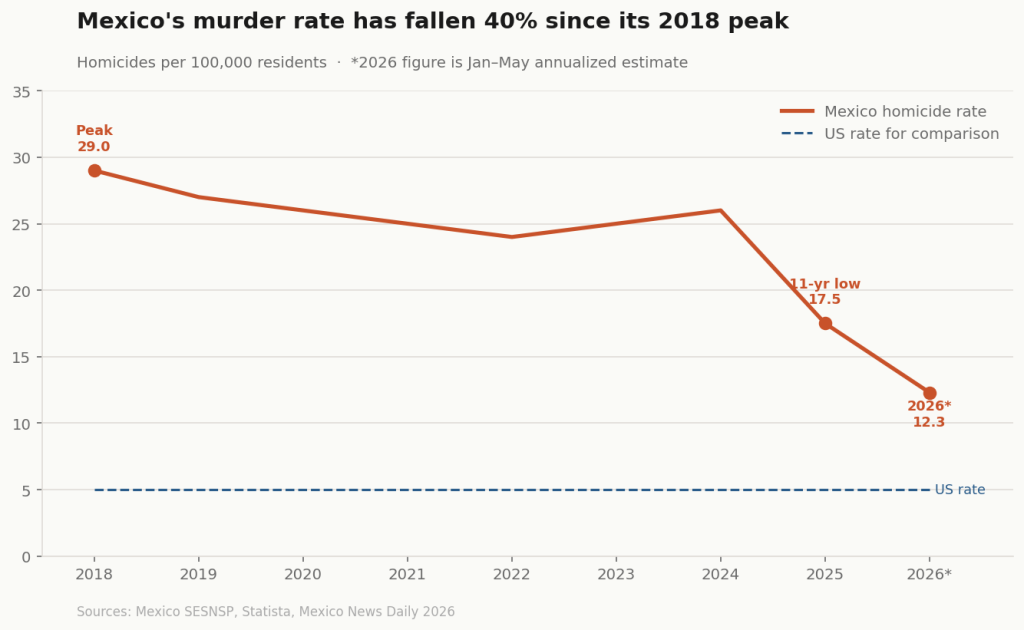
When people warn you about Mexico, they’re usually armed with one statistic: the national homicide rate. And yes, Mexico’s national rate of around 17.5 murders per 100,000 people is higher than the United States’ 5 per 100,000. Case closed, right?
The conversation has a script by now. Someone finds me on a video call, concern etched across their face. ‘Have you seen the news? A foreign tourist went missing in Cancún.” And I’ll ask them — when was the last time you heard of something like that happening? And there’s always a pause. A long one. Because they can’t remember. Not last month, not last year. They’re struggling to recall a single prior incident because these events are so rare they become national news precisely because of how unusual they are.
That’s the tell. When something happening in Mexico is genuinely shocking, it’s because it almost never happens. The story wouldn’t exist if it weren’t the exception.
Because that national homicide number is built almost entirely on violence happening in a handful of specific states, Guanajuato, Sinaloa, Chihuahua, Baja California, driven by cartel turf wars that have nothing to do with where tourists go or what tourists do. In the first five months of 2026, 54% of all homicides in Mexico occurred in just 8 states. The math on that is striking: 46% of the country’s murders are spread across the remaining 24 states, roughly 75% of Mexico’s geography.
Meanwhile, Mexico just reported its lowest homicide rate in 11 years. The January–May 2026 period was the least violent start to a year since 2015, down nearly 30% from the same period in 2025. The trajectory is going one direction.
"Nobody ever leans over and says did you hear what happened last night. Not because we're avoiding the subject. Because there's nothing to avoid. It simply isn't the texture of daily life here."
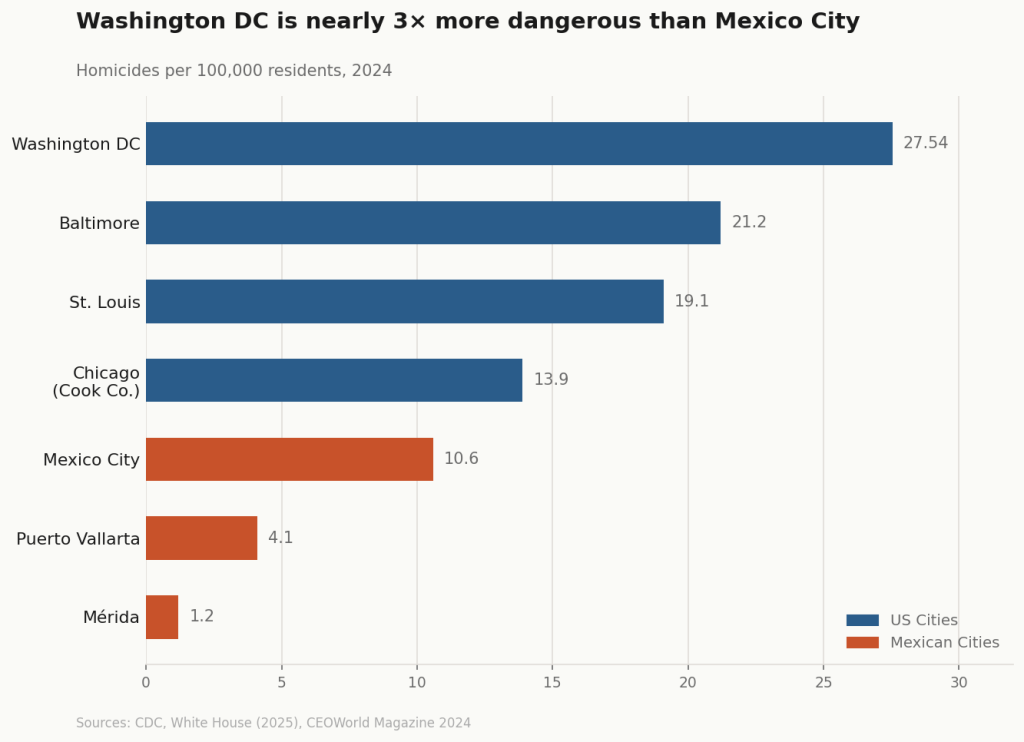
Here’s a comparison you won’t see in a State Department warning. Washington DC recorded a murder rate of 27.54 per 100,000 in 2024. Mexico City’s was 10.6. The US capital is nearly three times more dangerous than Mexico’s capital by that measure, and that’s a number the White House itself cited.
But let’s go further. The United States has recorded 167 mass shootings so far in 2026, roughly one every single day, defined simply as four or more people shot in a single incident. Grocery stores, schools, concerts, churches, Fourth of July parades. The person forwarding you a State Department warning about Mexico likely drove past three of these locations on the way to their computer.
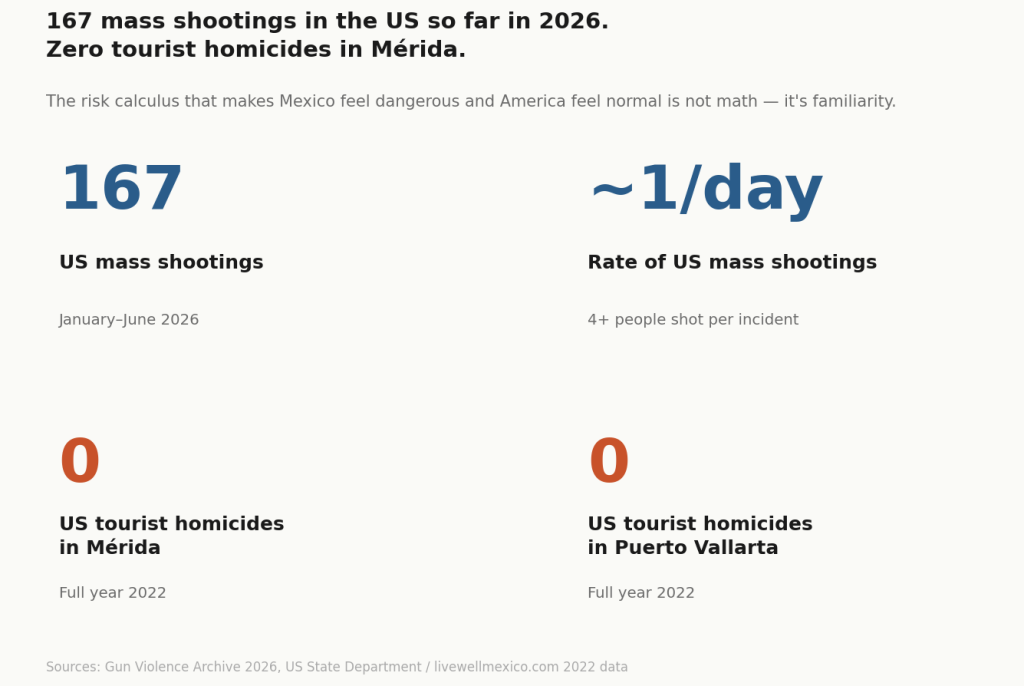
And the cities most tourists actually visit in Mexico tell a completely different story than the national average:
That last statistic deserves a moment. Across nine of Mexico’s most popular expat and tourist destinations, not a single American was killed in an entire year.
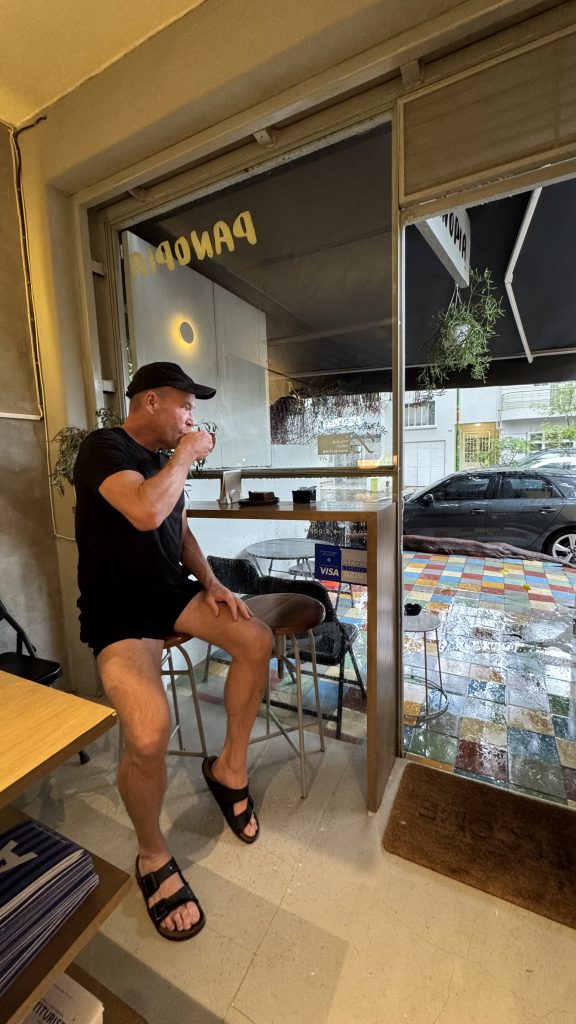
I live in Colonia Americana, a neighborhood in Guadalajara that feels more like a European quarter than anything the State Department warnings would have you picture. Most mornings I walk around the corner to my regular café, order a latte, and run into the same neighborhood faces. The conversation is always some version of the same thing, a new bar that just opened two streets over, a restaurant someone discovered last weekend, where people are heading next. Oaxaca, maybe. The coast.
Nobody ever leans over and says “did you hear what happened last night.” Not because we’re avoiding the subject. Because there’s nothing to avoid. It simply isn’t the texture of daily life here.
"Most Mexicans I know don't experience American coverage of their country as journalism. They experience it as something closer to propaganda."
There’s a structural reason tourists are safe that rarely gets discussed: tourism is roughly 8-9% of Mexico’s GDP. Every beach hotel, every taco stand, every Airbnb host, every tour operator, and yes, even the cartels who tax local economies, have a direct financial interest in tourists feeling safe and being safe. A dead tourist is an international incident. It brings federal attention, media coverage, and threatens the economic engine of entire regions.
This isn’t naive optimism. It’s incentive structure. The cartels are running a business. Targeting tourists is spectacularly bad for business.
There’s a telling reaction you notice after living here long enough. Bring up safety around Mexicans, your neighbors, the guy who runs your café, friends you’ve made over three years, and watch what happens. An eye roll. A groan. Sometimes a short, dry laugh.
Not because they’re dismissive of violence. They know better than anyone that Mexico carries real dangers, and that those dangers fall hardest on them. A Mexican living in a contested neighborhood carries a risk profile that no foreign visitor comes close to. The privilege of being a foreigner here is invisible until you understand it , and then it’s impossible to unsee. Tourists, expats and immigrants move through Mexico wrapped in a layer of economic and diplomatic insulation that most Mexicans simply don’t have.
The eye roll is about something else. It’s about turning on American news and watching their country get flattened into a single terrifying headline, over and over, while the complexity, the beauty, and the 130 million people living ordinary lives disappear entirely. Most Mexicans I know don’t experience American coverage of their country as journalism. They experience it as something closer to propaganda, a relentless, decontextualized loop that says one thing about a place they love and live in and recognize almost nothing of.
"The cartel violence was real. The threat to tourists was not. But only one of those things went viral."
Here’s the darkly funny part about the February cartel violence in Jalisco, I missed it entirely. I was in Florida visiting my mother when it happened. So for once, I was watching Mexico on American television the same way everyone else was.
My phone lit up within hours. Friends, family, the whole roster. “Are you okay? Have you seen what’s happening?” I had. I was watching the same footage they were, the chaos, the military convoys, the burning vehicles. And then something started appearing that gave me pause: images of planes on fire at the Guadalajara airport. Dramatic, terrifying, shareable. Also AI-generated. Manufactured images circulating alongside real footage, and almost nobody stopping to question which was which.
I told everyone the same thing: this is real, it’s serious, but it won’t last. Two days, maybe three. This is a targeted military operation against a cartel leader, not a war on tourists. The people being killed were cartel members and about a dozen Mexican military in the operation and subsequent reprisals. Nobody was hunting foreigners.
I was right about the timeline. What I underestimated was the damage already done. When I got back, the numbers were staggering, hotels in Puerto Vallarta and Guadalajara were reporting cancellation rates of 90%. Ninety percent. An entire tourism economy kneecapped in 48 hours by a news cycle, AI imagery, and an algorithm that had no interest in the follow-up story.
The cartel violence was real. The threat to tourists was not. But only one of those things went viral.
I’ve spent enough time in San Miguel de Allende to know it well. It is one of those places that stops you mid-stride, colonial architecture in colors that shouldn’t work together but do, artists everywhere, restaurants spilling out onto cobblestone streets, a pace of life that feels almost deliberately unhurried. I walk those streets at night without a second thought. Not bravely. Not naively. Just the way you walk through a place that has never given you a reason to think twice.
And yet, less than 50 miles to the south, Guanajuato state has been hosting one of Mexico’s most brutal cartel conflicts for several years. The same state. The same statistics. A completely different world.
The violence in Guanajuato is concentrated in a specific southern corridor (Celaya, Irapuato, Salamanca) cities locked in a turf war between the Jalisco New Generation Cartel and the Santa Rosa de Lima Cartel. The US Embassy has restricted its own employees from traveling on Highway 45D through that zone. San Miguel sits north of that corridor, functions almost as a separate world, and has a massive year-round expat population of Americans and Canadians who collectively constitute the city’s economic backbone.
That distance, geographic, experiential, statistical, is exactly why state-level crime data is almost useless as a travel tool. Guanajuato shows up as Mexico’s most violent state and San Miguel de Allende gets swept into that headline, when the reality on the ground is that they might as well be in different countries. The people booking and canceling trips to San Miguel based on Guanajuato’s homicide numbers are making decisions with the wrong map.
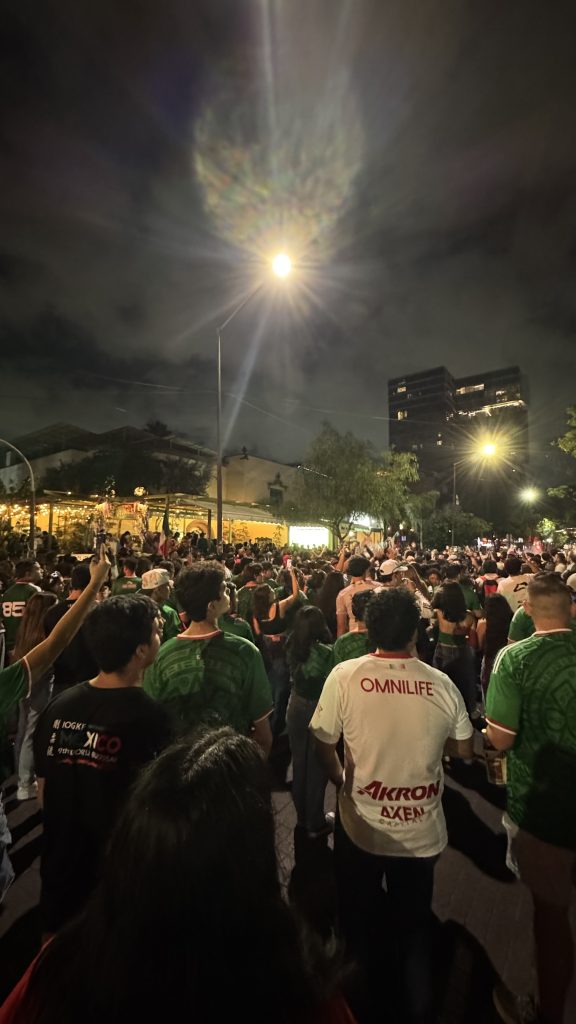
As I write this, Mexico is hosting the World Cup. Mexico City, Guadalajara, and Monterrey are among the host cities, and if you want to understand the gap between the Mexico that exists and the Mexico that gets reported, just look at what’s happening in those streets right now.
I’ve watched these cities prepare for years, the infrastructure, the anticipation, the pride building like a slow wave. And now it’s here, and the wave has broken. Walking through Guadalajara during match days is something I won’t forget easily. The city is radiating. There’s no other word for it. Mexicans who have waited their whole lives to show the world what their country actually looks like are getting their moment, and they are not wasting it. Strangers from many countries wandering neighborhoods across Mexico, eating street food, getting happily lost, being welcomed with a warmth that doesn’t make the evening news because warmth never does.
No violence. No incidents. Just an enormous, complicated, beautiful country putting its best self on display for the world — and the world, for once, actually showing up to see it.
For a tourist visiting Puerto Vallarta, Mérida, San Miguel, Oaxaca, Mexico City, Cabo, Sayulita, or the Riviera Maya, the honest answer is yes, by any reasonable statistical measure. Safer than many American cities you’d visit without a second thought.
Is all of Mexico safe? No. There are places, specific cities in Guanajuato, Sinaloa, parts of Guerrero, where the warnings reflect something real on the ground. The cartels are real. The violence is real. Nobody living here honestly would tell you otherwise.
But the warning covers the whole country, the news covers the worst incidents, and the algorithm serves Americans the most alarming version of Mexico it can find. The result is millions of people skipping one of the world’s great travel destinations based on a statistical illusion, making decisions with the wrong map, about the wrong Mexico, informed by a news cycle that had no interest in the follow-up story.
This is the Mexico I live in. It has been here the whole time.
I share where to stay, where to go and what it’s really like travelling to Mexico as an LGBTQ+ traveler based on real experiences on the ground.
About the Author
Tim is a seasoned gay travel writer and the creator of Out in Mexico, a dedicated resource for gay travelers exploring Mexico’s vibrant destinations. After relocating to Guadalajara, he has spent years immersing himself in Mexico’s gay culture, from the iconic beaches of Puerto Vallarta to the nightlife of Mexico City.
With firsthand experience in Mexico’s gay scene, Tim has personally visited the bars, hotels, and events featured in this guide. His insights have helped gay travelers plan unforgettable trips while ensuring they feel safe, welcomed, and informed.
When he’s not writing, you’ll find him sipping a mezcal cocktail at a bar in Colonia Americana or travel to a new exciting destination in Mexico.
📍 Follow his adventures: @i.am.out.in.mexico
I share where to stay, where to go and what it’s really like travelling to Mexico as an LGBTQ+ traveler based on real experiences on the ground.
Gay-Friendly Bars, Restaurants, Culture
Local Tips You Won’t find on Google
Delivered straight to your Inbox twice a month

No Comments